
Sun Protection for Vitiligo: Why SPF 50 Isn't Optional and How to Apply It Right
Depigmented vitiligo patches contain no melanocytes, which means they produce no melanin at all. Melanin is what absorbs UV radiation before it reaches the deeper layers of the skin — without it, there is no natural protection. That patch on your forearm burns faster than the surrounding skin, cannot tan to match it, and accumulates UV damage with nothing to buffer it. Sun protection for vitiligo is not a cautious recommendation — it is filling in for a function the skin has lost entirely.
Why vitiligo skin burns differently
Normal skin tone varies, but even the lightest skin has some melanin in functioning melanocytes. Depigmented vitiligo patches have none. The melanocytes are absent or non-functional, so the UV-absorbing pigment they produce does not exist in those areas.
The practical consequence is straightforward: SPF 30 on a depigmented patch is not the same as SPF 30 on unaffected skin. SPF ratings are calculated for skin with at least some natural pigmentation as a baseline. When that baseline is zero, the patch is starting from a more vulnerable position before sunscreen even enters the equation. The standard dermatology guidance for vitiligo is SPF 50 minimum on exposed depigmented areas — not SPF 30, which is adequate for normal skin in most conditions.
There is also an asymmetry problem. Sun exposure causes surrounding normal skin to tan and deepen in colour. The vitiligo patch cannot tan. The result is that unprotected sun exposure makes the contrast between depigmented patches and surrounding skin more visible, not less. Applying sunscreen only to the patches misses this — the whole area needs to be covered.
Mineral vs chemical sunscreen for vitiligo
The main functional distinction between sunscreen types is how they work: mineral sunscreens (zinc oxide, titanium dioxide) sit on the skin surface and physically reflect UV radiation, while chemical sunscreens absorb UV energy and convert it to heat through a chemical reaction.
For vitiligo patients — particularly those actively pursuing repigmentation — mineral sunscreens are the preferred default for several reasons:
- Zinc oxide and titanium dioxide do not inhibit tyrosinase. Tyrosinase is the enzyme that drives melanin production. Anything that dampens tyrosinase activity works against repigmentation. Mineral UV filters do not affect this pathway.
- Chemical UV filters are not proven to inhibit tyrosinase, but zinc oxide has been more thoroughly evaluated in this context and is the safer default for patients using active treatments like tacrolimus, ruxolitinib, or narrowband UVB.
- A note on vitamin C: High-concentration vitamin C (ascorbic acid) is a known tyrosinase inhibitor — it is actually used in skin-brightening products for that reason. Check the ingredient list of any chemical sunscreen you are considering; a formula that leads with ascorbic acid is not ideal for patients trying to repigment.
- Mineral formulas tend to be better tolerated on skin that is already reactive from topical prescription use.
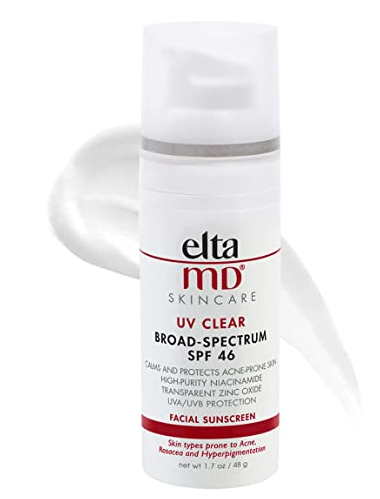
For facial patches, EltaMD UV Clear SPF 46 is the top mineral recommendation — it uses zinc oxide as the active, is non-comedogenic, carries no white cast, and contains niacinamide which supports skin barrier function. A full comparison of mineral and tinted options is on the best sunscreen for vitiligo page.
For facial patches
EltaMD UV Clear SPF 46
Zinc oxide active, non-comedogenic, no white cast, with niacinamide for barrier support — the top mineral pick for facial vitiligo patches.
Check Price on AmazonSPF timing for phototherapy patients
This section matters more than most patients realise, and getting it wrong can actively reduce the effectiveness of phototherapy treatment.
Narrowband UVB (NbUVB) works by delivering calibrated therapeutic UV doses to the skin. Sunscreen applied to treatment areas before a session blocks that UV — meaning it blocks the treatment itself. Do not apply sunscreen to areas being treated with narrowband UVB before a session.
The correct protocol:
- Before a session: No sunscreen on treatment areas.
- After a session: Wait 15–30 minutes for skin to cool, then apply SPF 50 mineral sunscreen to treated areas if you are going outdoors.
- On non-treatment days: Apply sunscreen normally, same as any other day.
For patients using a home UVB lamp, more on the full session protocol is in the narrowband UVB at home guide.
Opzelura (ruxolitinib cream) users: Opzelura does not contain a UV filter and does not block UV. Apply sunscreen over treated areas as normal — there is no timing restriction around the cream application. The Opzelura complete guide covers layering and timing in more detail.
How to apply (what most people get wrong)
The most common sunscreen mistake is not using the wrong product — it is applying too little of the right one. SPF ratings are measured using 2mg per cm² of skin. In practice, most people apply a quarter to a half of that amount, which means your SPF 50 sunscreen is delivering roughly SPF 7 to SPF 15 in real-world use.
For the face and neck: About a quarter teaspoon of sunscreen is the correct amount. Apply it before going outside, let it settle for a few minutes, and reapply every two hours outdoors.
For body patches: A dedicated body sunscreen is more practical than extending facial formula to large areas — both for cost and for texture. Blue Lizard Sensitive SPF 50 is a mineral body formula that applies well over larger areas without excessive white cast. Reapply after swimming or sweating regardless of elapsed time.
For body patches
Blue Lizard Sensitive SPF 50
A mineral body formula built for larger surface areas — applies without excessive white cast, so you'll actually reapply it.
Check Price on AmazonThe most frequently missed spots: Hands and feet. These are among the hardest areas to treat for vitiligo repigmentation — the acral areas (extremities) have a depleted melanocyte reservoir and respond slowly to treatment. They are also among the most UV-exposed areas during daily life. Apply sunscreen to the backs of the hands every morning without exception.
For large body surface areas, La Roche-Posay Anthelios SPF 60 is a higher-SPF option that works well for broad application where maximum protection is the priority.
Protective clothing
For large vitiligo patches on the arms, legs, or trunk, UPF 50+ clothing is more reliably protective than sunscreen — it does not wash off, does not thin out with application, and requires no reapplication. Modern sun-protective fabrics are lightweight and available in everyday cuts.
Practical items worth considering: protective clothing with UPF 50+ rating for arms and legs on high-exposure days, a wide-brim hat for facial and neck patches, swim shirts for the beach or pool, and lightweight driving gloves for hand patches during long drives (the glass in car windscreens blocks UVB but not all UVA — an often-overlooked exposure route).
The clothing approach is particularly practical for anyone managing widespread vitiligo where applying sunscreen to a large surface area twice daily becomes a significant daily task. For the face and hands, sunscreen remains necessary — clothing cannot reliably cover those areas.
The contrast problem: why protecting unaffected skin matters too
Vitiligo patients often focus their sun protection on the patches themselves — which is correct, but incomplete. Unprotected normal skin tans in response to UV exposure. Vitiligo patches cannot tan. The practical result: sun exposure without full-area protection makes the visible contrast between patches and surrounding skin darker and more noticeable.
Apply sunscreen to the whole area, not just the white patches. This is not about protecting the patches from the outside — it is about keeping the surrounding skin from deepening in tone and widening the visual gap. In practical terms, if you have vitiligo on your forearm, sunscreen goes on the entire forearm, not just the depigmented sections.
This also applies to self-tanning products used to reduce contrast. If surrounding skin continues to tan from UV exposure while a self-tanner is applied to patches, the effect is quickly reversed.
Beth’s take
Sun protection will not repigment vitiligo. That point is worth being clear about — some patients over-invest in sunscreen hoping it will reverse their patches, and it will not. What it does is prevent avoidable UV damage to skin that has zero natural protection, maintain the results of treatment-achieved repigmentation over time, and stop surrounding normal skin from deepening the visual contrast through tanning.
The mineral/zinc oxide preference over chemical UV filters is a practical tiebreaker, not a strict rule. If you tolerate a chemical sunscreen well and it is the product you will actually use consistently, using it correctly is far more valuable than using a mineral formula incorrectly or sporadically. The dose matters more than the formula.
Sun protection is one part of the overall management picture — it does not replace treatment, but it makes the rest of the work more durable.
Frequently asked questions
Can sunscreen help repigment vitiligo?
No. Sunscreen protects existing repigmentation that has been achieved through treatment, and protects depigmented skin from UV damage. It does not initiate or stimulate the repigmentation process. Treatments like narrowband UVB, ruxolitinib cream, and tacrolimus are what drive repigmentation — sunscreen supports the results.
What SPF is recommended for vitiligo?
SPF 50 or higher on depigmented patches and exposed skin. SPF 30 is the general population minimum but is not adequate as the baseline for vitiligo patches, which have no melanin to contribute any additional UV absorption. At real-world application levels, SPF 50 delivers approximately SPF 15–25 in practice — starting at SPF 30 leaves less margin.
Should I use sunscreen if I am doing phototherapy?
Yes, but with timing. Do not apply sunscreen to treatment areas before a narrowband UVB session — it blocks the therapeutic UV. Apply sunscreen to treated areas after sessions (wait 15–30 minutes post-treatment). On non-treatment days, apply normally. The narrowband UVB at home guide covers the full session protocol.
Does sunscreen prevent vitiligo from spreading?
Not directly. Sunscreen does not stop the autoimmune process that drives vitiligo. However, protecting against sunburn reduces the risk of the Koebner phenomenon — where physical trauma to the skin, including UV burns, can trigger new vitiligo lesions at the damage site. There is some evidence that UV damage can trigger new patches in Koebner-positive patients, which makes sun protection a reasonable precaution for slowing spread even if it cannot stop the underlying condition.
