
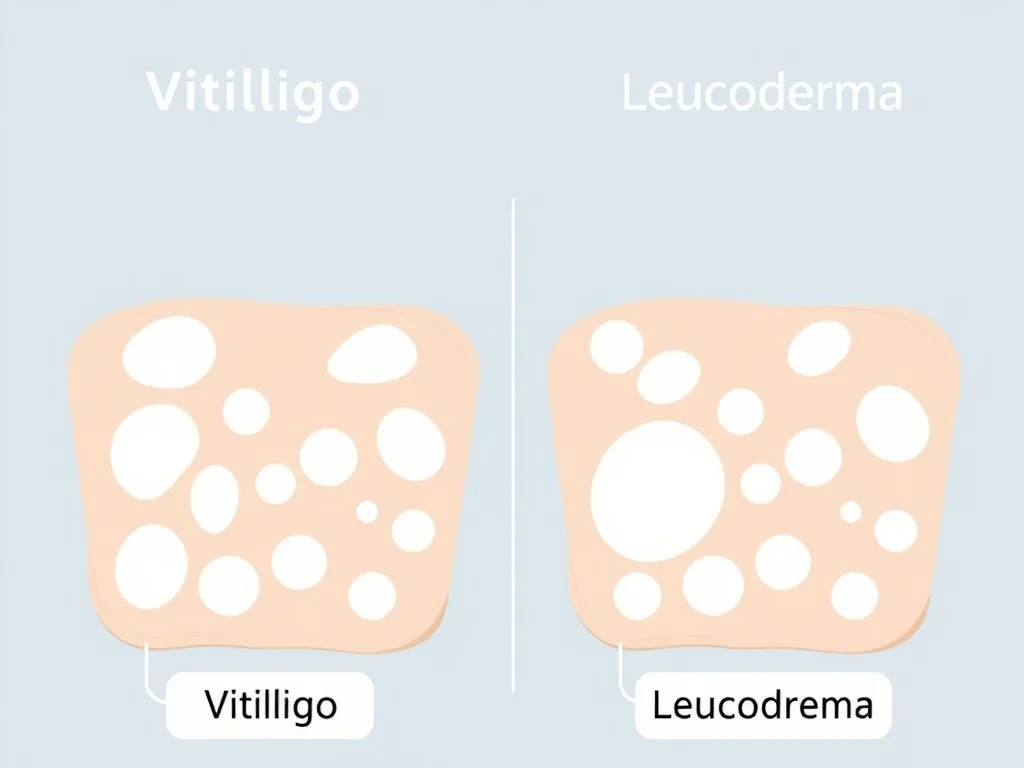
Vitiligo vs Leucoderma: Are They the Same Thing?
If you searched “leucoderma vs vitiligo” or “is leucoderma the same as vitiligo,” you are almost certainly from a South Asian background, or you have been given one of these terms by a doctor or family member and you are trying to understand whether they mean the same thing.
The short answer: leucoderma is a general term that includes vitiligo. Vitiligo is the most common and well-defined cause of leucoderma. In everyday clinical use — particularly in India and Pakistan — the terms are used interchangeably. But they are technically different in scope.
What leucoderma means
“Leucoderma” is a descriptive term, not a specific diagnosis. It comes from the Greek: leuco (white) + derma (skin). It literally means “white skin” — any condition that causes white patches or depigmentation of the skin.
Conditions that fall under the leucoderma umbrella include:
- Vitiligo — the most common cause of leucoderma; autoimmune destruction of melanocytes
- Post-inflammatory hypopigmentation — white patches left after a skin injury, infection, or inflammatory skin condition heals; not autoimmune
- Tinea versicolor — a fungal infection that can leave light patches, particularly on the trunk; not autoimmune; treatable with antifungal medication
- Pityriasis alba — common in children; light patches on the face usually related to mild eczema; usually temporary
- Chemical leucoderma — depigmentation triggered by exposure to certain chemicals (rubber gloves, adhesives, some industrial chemicals) that are toxic to melanocytes
- Piebaldism — a rare genetic condition present from birth that causes white patches due to absent melanocytes in those areas
All of these produce white or pale patches on the skin. All of them are, in the broadest sense, “leucoderma.” But they have different causes, different prognoses, and different treatments.
What vitiligo means
Vitiligo is a specific, well-defined autoimmune condition in which the immune system attacks and destroys melanocytes — the cells responsible for producing skin pigment. Vitiligo produces white patches that:
- Are typically completely depigmented (stark white, not just pale)
- Develop over time rather than being present from birth
- Often appear symmetrically
- Are associated with other autoimmune conditions at elevated rates
- Respond to immunomodulatory and phototherapy treatments
Vitiligo is the most common cause of leucoderma worldwide. When someone in an Indian or Pakistani clinical context says “leucoderma,” they almost always mean vitiligo specifically.
Why the terminology matters
The distinction between leucoderma as a general category and vitiligo as a specific diagnosis matters for several reasons.
Diagnosis: If you have white patches, the first step is confirming you have vitiligo rather than one of the other conditions that can cause white skin. A dermatologist will use Wood’s lamp examination (which makes vitiligo patches fluoresce with a bright whitish glow), dermoscopy, and clinical assessment of pattern and history to distinguish vitiligo from other causes. The difference between tinea versicolor and vitiligo is worth reading if there is any uncertainty about your diagnosis — the two are often confused.
Treatment: Post-inflammatory hypopigmentation often resolves on its own. Tinea versicolor is treated with antifungals, not immunomodulators. Chemical leucoderma may stabilise once the chemical exposure stops. Vitiligo requires specific treatments — phototherapy, JAK inhibitors, calcineurin inhibitors — that are appropriate for autoimmune disease. Treating tinea versicolor with vitiligo medications would miss the actual cause.
Prognosis: The outlook for white patches differs significantly depending on the cause. Pityriasis alba usually resolves in children. Post-inflammatory hypopigmentation frequently repigments with time. Vitiligo is a chronic autoimmune condition requiring ongoing management.
Stigma: In South Asian communities, “leucoderma” and “vitiligo” carry stigma that is historically tied to confusion with leprosy. Vitiligo is not contagious, not related to leprosy, and is an autoimmune condition — not a spiritual punishment, a dietary failing, or a sign of impurity. If you have received these messages from family or community, they are factually wrong. The is vitiligo contagious article addresses this directly.
Why doctors in India use leucoderma
In Indian and Pakistani medical practice, “leucoderma” became the dominant clinical term for vitiligo through a combination of historical and linguistic reasons. British colonial medical texts used the term; it entered Urdu, Hindi, and regional language medical vocabularies as the standard descriptor. Ayurvedic and Unani medical traditions also use leucoderma as a translation for the conditions they recognise as shwitra (Sanskrit) or bars (Arabic/Urdu).
This is why if you see a dermatologist in India, they may write “leucoderma” in your notes even when they mean vitiligo specifically. Internationally, “vitiligo” is the standard term in clinical research, FDA approvals, and treatment guidelines. The treatments available globally — including Opzelura, narrowband UVB, tacrolimus — are for vitiligo, and the research behind them is labelled as vitiligo research. When looking for treatment information, searching “vitiligo” will give you access to the full international evidence base.
So: are they the same thing?
In the way the terms are used in everyday clinical practice in South Asia: yes, essentially. When a doctor says leucoderma, they almost always mean vitiligo.
In the technically precise sense: leucoderma is the category, vitiligo is the most common disease within it. They are not identical, because not all leucoderma is vitiligo.
If you have been told you have leucoderma and are wondering what treatment to pursue, the appropriate next step is confirming whether the specific cause is vitiligo (through dermatological assessment) before committing to a treatment plan. Assuming it is vitiligo and treating accordingly is usually correct — but it is worth ruling out other causes, especially if the patches appeared suddenly after a skin injury or infection, or if they have an unusual pattern.
The vitiligo diagnosis and treatment overview covers what a proper diagnostic workup looks like if you are at the start of this process.
