
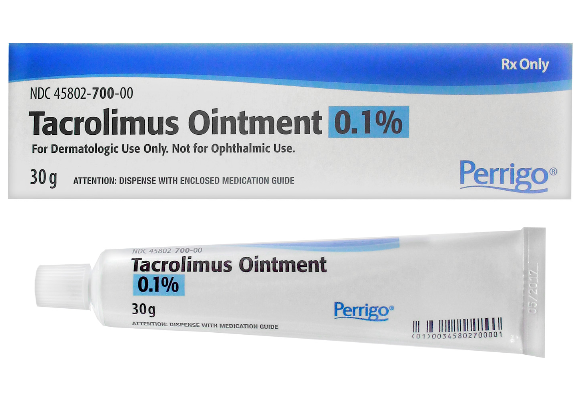
Tacrolimus Ointment for Vitiligo: Where It Fits Best
Tacrolimus ointment is one of the prescription treatments that comes up again and again in real vitiligo care, especially when the patches are on thinner or more delicate skin.
It is not exciting in the way newer treatments are exciting, but it is relevant, common, and worth understanding properly.
Where tacrolimus usually fits
Tacrolimus is often discussed for areas where long-term steroid use can be more problematic, such as:
- the face
- around the eyes
- the neck
- other thinner skin areas
That does not mean it is the right answer for everyone. It means it often has a practical role in the treatment conversation.
How it actually works
Tacrolimus belongs to a drug class called topical calcineurin inhibitors — the same family as pimecrolimus (Elidel). Rather than broadly suppressing skin cell activity the way topical steroids do, it blocks calcineurin, an enzyme T cells need to activate and produce the inflammatory signals that drive the immune attack on melanocytes. Interrupting that signal at the local, skin level is what allows surviving melanocytes the chance to begin repigmenting a patch.
The practical upside of that mechanism is the reason tacrolimus gets reached for on the face, eyelids, and neck so often: unlike topical corticosteroids, it does not carry the risk of skin thinning (atrophy), stretch marks, or the visible blood vessel changes that come with long-term steroid use on delicate skin. That makes it a genuinely better long-term option for facial vitiligo specifically, even though it is not necessarily faster or more effective than a steroid in the short term.
Tacrolimus vs. pimecrolimus (Elidel)
Both drugs are topical calcineurin inhibitors and both show up in vitiligo treatment plans, which understandably causes confusion about which one to expect. The practical differences:
- Potency. Tacrolimus ointment, especially at 0.1%, is generally considered somewhat more potent than pimecrolimus cream. Dermatologists often reach for tacrolimus first on facial vitiligo where a stronger local effect is wanted.
- Formulation. Tacrolimus is an ointment (thicker, more occlusive); pimecrolimus is a cream. Some patients find the ointment texture harder to tolerate cosmetically, particularly on the face during the day.
- Typical use case. Pimecrolimus is more frequently used in very young children or in situations where tolerability is prioritized over strength — for a deeper look at that comparison, see Elidel (pimecrolimus) for vitiligo.
- Evidence base. Tacrolimus has a larger body of vitiligo-specific trial data, including head-to-head comparisons against other treatments (see below). Pimecrolimus has less vitiligo-specific trial data but a long, well-established safety record from eczema treatment.
Neither is universally “better.” The choice usually comes down to the specific area being treated, the patient’s age, and how the skin tolerates each formulation.
Age restrictions and use in children
Tacrolimus ointment 0.03% is FDA-approved for eczema in children as young as two years old, and this lower-strength formulation is the one most commonly used off-label for vitiligo in children, under a pediatric dermatologist’s supervision. The 0.1% strength is typically reserved for adults and older adolescents, since it is a stronger formulation with a correspondingly higher chance of local irritation.
Parents should expect a slower, more cautious protocol in children — smaller treatment areas, closer monitoring for irritation, and realistic expectations that response in pediatric vitiligo, while often good, still takes months rather than weeks. If your child has recently been diagnosed, vitiligo in children covers the broader treatment landscape beyond tacrolimus alone.
Buying tacrolimus outside the US
In the US, UK, and most of Europe, tacrolimus ointment (branded Protopic) requires a prescription. Some patients, particularly those without easy dermatologist access or facing high prescription costs, look at international pharmacies where the drug may be available with fewer restrictions.
I would treat this route with real caution. Beyond the obvious legal and import issues, the practical risks are concentration errors (0.03% vs 0.1% matters clinically), unverified product sourcing, and — most importantly — no dermatologist tracking how your skin is actually responding or tolerating it. Calcineurin inhibitors are generally very safe when used as directed, but “as directed” is doing real work in that sentence. If cost is the barrier, ask your dermatologist about generic tacrolimus (it is off-patent and considerably cheaper than Protopic) or manufacturer/pharmacy discount programs before considering unregulated sourcing.
What the evidence shows
Tacrolimus ointment 0.1% has been studied head-to-head against oral tofacitinib (a JAK inhibitor) in a 2023 randomised controlled trial in patients with localised vitiligo. The tofacitinib group achieved meaningful repigmentation in 47% of patients versus 37% in the tacrolimus group, with tofacitinib working faster (median 8 weeks vs 12 weeks to first response). The difference was statistically significant but the absolute gap is modest — particularly for facial patches, where both treatments perform better than on hands and feet.
The more practically useful data is older: a systematic review of topical calcineurin inhibitors in vitiligo (van Geel et al.) found that around 50–75% of patients with facial vitiligo achieve at least some repigmentation with consistent tacrolimus use over 3–6 months. Response rates drop significantly for acral (hands, feet) and bony prominences.
Tacrolimus 0.03% (the lower-strength formulation used for children) appears similarly effective on the face with a better tolerability profile for paediatric patients.
What patients should expect
The usual rhythm with tacrolimus is slower than people want. It often needs consistent use, patience, and sometimes a combination strategy rather than being treated like a stand-alone fix.
This is one reason people get discouraged too early. Vitiligo treatment often rewards consistency more than intensity.
Common questions worth asking
If your dermatologist recommends tacrolimus, I would ask:
- Is this mainly to stabilize the area, encourage repigmentation, or both?
- Is this a good choice for the location of my patches?
- Should it be used alone or with narrowband UVB?
- What irritation or burning is normal, and what is not?
That kind of clarity matters more than generic internet instructions.
Side effects and tradeoffs
Some people get burning, stinging, or irritation, especially early on. That does not automatically mean the medicine is wrong for you, but it does mean follow-up matters. Like most topical treatment pages, this one should not pretend the experience is identical for everyone.
Sun protection also still matters. Even when a cream is appropriate, it does not replace the basics — and a gentle moisturizer applied after treatment helps tolerance.
My take
Tacrolimus is one of those treatments that makes more sense the more grounded your expectations are. It is not flashy, but it is often genuinely useful, especially in the right location and as part of a combined plan.
For related treatment comparisons, continue with:
