
Home Narrowband UVB Safety Guide: Doses, Risks, and How to Get It Right
Home narrowband UVB phototherapy has become one of the most practical options for vitiligo patients. The devices are accessible, the evidence is solid, and treating at home 3 times a week is far more realistic for most people than driving to a clinic the same number of times.
But “home” does not mean “no protocol required.” UV dose, session frequency, protective measures, and how you handle progression all matter — and the lack of a supervising clinician means you need to understand the logic, not just follow steps blindly.
This guide covers the full safety framework for home NbUVB in vitiligo.
How narrowband UVB works in vitiligo
Narrowband UVB (311–313nm) treats vitiligo through two complementary mechanisms:
-
Immunosuppression — NbUVB reduces T-cell activity in the skin, dampening the autoimmune attack on melanocytes. This is why it helps stabilize active vitiligo.
-
Melanocyte stimulation — UV exposure triggers melanocytes in the outer root sheaths of hair follicles to proliferate and migrate outward into the depigmented patch. This is how repigmentation actually happens — and why areas without follicles (palms, soles, fingertips) respond poorly.
The narrowband (311nm) wavelength is more effective than broadband UVB for both mechanisms and has a better safety profile than PUVA (psoralen + UVA).
Choosing a device
Home NbUVB devices range from full-body panels to handheld wands to scalp combs. The right choice depends on where your patches are:
| Device type | Best for |
|---|---|
| Full-body panel | Widespread patches on trunk, limbs |
| Handheld wand | Localized patches; targeted treatment |
| Scalp comb | Scalp vitiligo through hair |
| Targeted excimer-style | Very localized; not standard home equipment |
Full comparison of home UV lamp options →
Make sure any device you use emits narrowband UVB (311nm). Broadband UVB, UVA, or “sunlight simulation” lamps are different and should not be substituted.
Starting dose: the Minimal Erythemal Dose (MED)
Clinic protocols determine starting dose by measuring the Minimal Erythemal Dose (MED) — the lowest UV dose that produces just-perceptible redness 24 hours after exposure on untreated skin.
At home without a MED measurement, most protocols recommend:
Conservative starting approach:
- Start at 50–70% of the estimated MED for your skin type
- A common home starting point is 30–60 seconds for a wand device held at the standard distance (typically 6 inches / 15cm), adjusted for Fitzpatrick skin type
| Fitzpatrick type | Skin description | Approximate starting exposure |
|---|---|---|
| I–II | Very fair, burns easily | 30 seconds at 15cm |
| III | Medium, tans gradually | 45 seconds at 15cm |
| IV | Olive/brown, rarely burns | 60 seconds at 15cm |
| V–VI | Dark brown or black | 60–90 seconds at 15cm |
These are conservative starting points. Consult the device manual for your specific device’s calibration — output varies by manufacturer and tube age.
The most important rule: The goal is to find the dose that produces mild pinkness lasting less than 24 hours. If you see significant redness, blistering, or redness lasting more than 48 hours, you have gone too high. Do not increase the dose the next session — hold at that dose or reduce it.
Session frequency
The evidence-based protocol for vitiligo is 3 sessions per week, on non-consecutive days (e.g., Monday/Wednesday/Friday). Consecutive-day sessions do not allow sufficient skin recovery between exposures.
Do not skip more than 4–5 days between sessions without recalibrating your dose. If you take a week or more off, reduce your dose by 25–50% and rebuild gradually.
Dose progression
Once you have established your starting dose, progress gradually:
- Increase by 10–15% per session if there is no erythema (redness) from the previous session
- Hold the dose if the previous session produced mild pink coloring that resolved within 24 hours — that is your target zone
- Reduce by 20–25% if the previous session produced significant redness or burning
- Stop and consult a dermatologist if you develop blistering, severe pain, or redness lasting more than 48 hours
The progression rate slows as you build up to therapeutic doses. Many patients reach a maintenance dose after 4–8 weeks and then hold relatively stable.
Areas that require special protection
Eyes
This is the most important safety point: never expose the eyes to narrowband UVB without protection.
NbUVB can cause photokeratitis (essentially sunburn of the cornea), cataracts with prolonged cumulative exposure, and retinal damage.
During every session:
- Wear UV-blocking goggles designed for phototherapy use (standard sunglasses are not sufficient — you need goggles that block 100% of UV and seal around the eyes)
- If treating patches near the eye, keep eyes closed and covered throughout
Genitals
Genital skin should be covered during full-body sessions unless you are specifically treating genital vitiligo under dermatologist guidance. The genital area has increased UV sensitivity and higher cumulative risk with repeated exposure.
Use tight-fitting underwear, swim trunks, or purpose-made protective wraps during panel sessions.
Face
If you are treating facial patches with a full-body panel or wand, protect the rest of the face from excess exposure if only targeting specific areas. A simple cloth or UV-opaque face mask works for this purpose.
Scalp
Scalp exposure during full-body panel sessions (without a scalp comb device) is inconsistent due to hair coverage. Use a dedicated scalp comb device for reliable scalp UVB delivery.
Skin that is already well-pigmented
Areas of normal skin adjacent to patches will also receive UV exposure. Over time, this can produce deeper tanning in already-pigmented skin, which can increase the contrast between treated patches and surrounding skin before repigmentation is complete. This is temporary and reverses once treatment stops or the patches repigment.
Sun protection (SPF 30+ daily) on all exposed skin outside of treatment sessions reduces background tanning of normally-pigmented areas and helps minimize this contrast.
Combining NbUVB with topicals
Home NbUVB works well in combination with topical treatments. The general protocol:
- Apply topicals after, not before, NbUVB sessions. Applying thick creams or ointments before treatment can scatter UV and reduce effective dose delivery.
- Tacrolimus + NbUVB: Well-studied combination; tacrolimus applied after each session.
- Ruxolitinib + NbUVB: Applied after session; enhances repigmentation.
- Calcipotriol + NbUVB: Some evidence of benefit; note that calcipotriol may reduce visible erythema, which can make dose-guiding harder.
- Moisturizer: Apply a fragrance-free moisturizer after sessions to support skin barrier.
More on the calcipotriol + NbUVB combination →
When NOT to use NbUVB
Home narrowband UVB is not appropriate for everyone. Discuss with your dermatologist if you have:
- Personal or family history of melanoma or non-melanoma skin cancer
- Xeroderma pigmentosum or other photodermatoses
- Lupus or other photosensitive conditions
- Active use of photosensitizing medications — many common drugs increase UV sensitivity, including: doxycycline, hydrochlorothiazide, amiodarone, some NSAIDs, St. John’s Wort, certain antibiotics
- Very fair skin (Fitzpatrick I) with multiple atypical moles
If you are on any prescription medication, check whether it is photosensitizing before starting home phototherapy.
How long to continue treatment
NbUVB is a long-term commitment. Most patients need:
- 3–6 months to see meaningful repigmentation starting
- 12–24 months to achieve substantial coverage on well-responding sites (face, trunk)
- Ongoing maintenance (1–2× per week) to prevent relapse once repigmentation is achieved
Stopping treatment abruptly often leads to gradual loss of repigmentation over 6–18 months. Many patients reduce to maintenance frequency rather than stopping entirely.
Signs that treatment is working
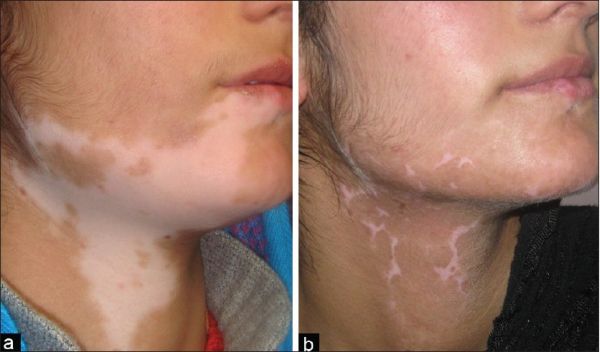
The earliest visible sign of repigmentation is perifollicular pigmentation — small dots of color appearing around hair follicles within the patch. These are easy to miss but are the first confirmation the treatment is reaching melanocytes.
From there, pigmentation spreads outward from each follicular island until the patch fills in. This process is slow — weeks to months per patch — and faster on the face than on the extremities.
Use consistent photography (same lighting, same angle, same distance) to track changes every 4–6 weeks. It is very easy to miss gradual improvement without documented comparison.
When to involve a dermatologist
Home phototherapy is appropriate for many patients, but some situations warrant professional guidance:
- Starting out, especially if you have fair skin or are on medications
- If you develop redness that does not resolve within 48 hours
- If you see blistering after any session
- If there is no visible change after 4–6 months of consistent treatment
- If vitiligo is actively spreading despite treatment
- If you want to combine NbUVB with systemic treatment (mini-pulse steroids, oral JAK inhibitors)
A dermatologist can also perform a formal MED test, which makes home dose calibration considerably more precise.
Beth’s take
Home NbUVB is one of the highest-value investments in vitiligo treatment for most patients — it is cost-effective over 2–3 years compared with clinic sessions, it is flexible, and the evidence is as strong as any treatment available.
The safety framework is not complicated, but it requires understanding, not just following steps. Know your starting dose, progress slowly, protect your eyes every session without exception, and be patient with the timeline.
If you are ready to explore devices:
- Best home UV lamps for vitiligo: compared and reviewed →
- Kernel vs. Daavlin vs. Dermfix UVB lamps compared →
- UVB comb vs. UVB panel — which fits your pattern →
- Best budget UVB devices under $300 →
- Your first week with a home UVB lamp: what to expect →
- Vitiligo treatment by body area — where NbUVB works best →
- What to combine with NbUVB: topical guide →
