
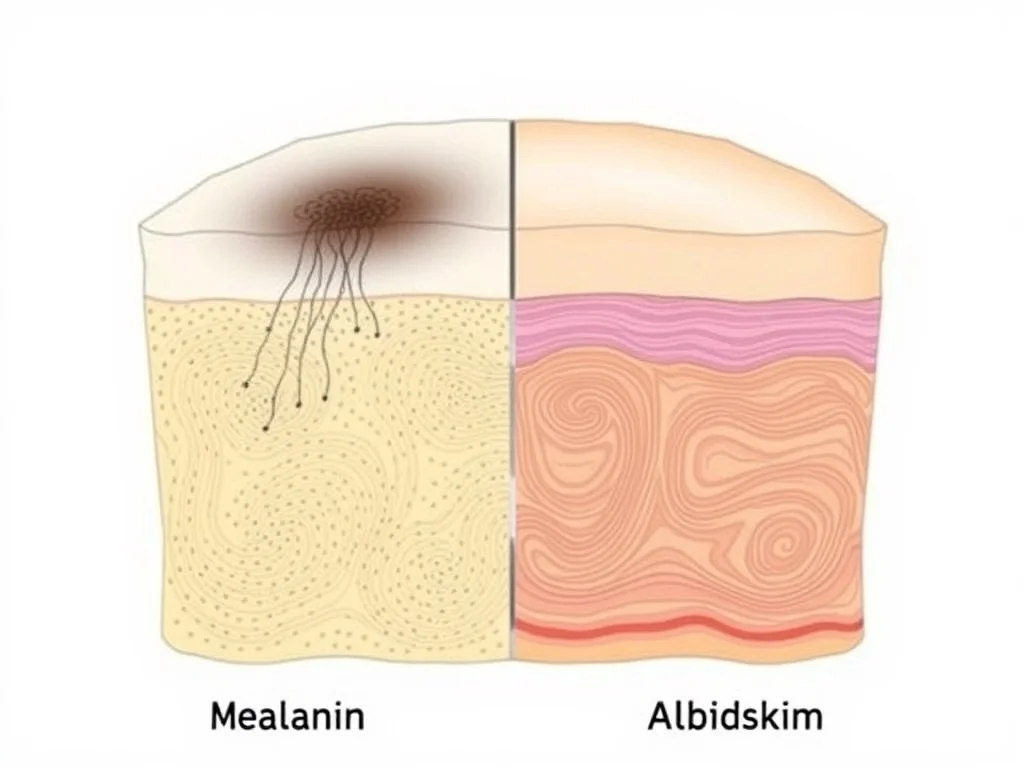
Vitiligo vs Albinism: Key Differences Explained
Vitiligo and albinism are frequently confused by people unfamiliar with either condition. Both involve reduced or absent skin pigmentation, and both produce a pale or white appearance in affected skin. Beyond that superficial similarity, they are entirely different conditions with different causes, different patterns, different associated features, and different treatment implications.
What albinism is
Albinism is a group of genetic disorders characterised by reduced or absent melanin production — not because melanocytes are destroyed (as in vitiligo) but because melanocytes lack the ability to produce melanin properly.
The most common forms involve mutations in the gene that encodes tyrosinase (the enzyme that initiates melanin synthesis) or genes involved in melanin processing and transfer. The result: melanocytes are present and alive but functionally unable to make adequate melanin.
Oculocutaneous albinism (OCA): Affects skin, hair, and eyes. Multiple subtypes (OCA1–OCA7) with different severity of melanin reduction — from complete absence (OCA1a, very pale skin and hair, pink eyes) to partial reduction (some pigmentation in hair and skin, reduced iris pigment).
Ocular albinism: Affects primarily the eyes, with more normal skin and hair pigmentation.
Albinism is present from birth — it is a congenital condition, not an acquired one. All melanocytes in the body are affected equally (they cannot produce melanin due to the genetic defect), producing a uniform reduction in pigmentation rather than patchy depigmentation.
What vitiligo is
Vitiligo is an autoimmune condition in which the immune system destroys melanocytes — the cells are present initially but are progressively killed by the autoimmune attack. Vitiligo:
- Is acquired (not present at birth; develops over time)
- Produces patchy depigmentation in discrete areas, not uniform reduction
- Progresses over time as new melanocytes are destroyed
- May respond to treatment that stops the autoimmune attack and stimulates surviving melanocytes
The distribution is the most immediately obvious difference: vitiligo produces white patches on otherwise normally pigmented skin. Albinism produces uniform reduction in pigmentation across all skin, hair, and usually eyes.
Key differences at a glance
| Feature | Vitiligo | Albinism |
|---|---|---|
| Cause | Autoimmune destruction of melanocytes | Genetic inability to produce melanin |
| Onset | Acquired; develops over time | Congenital; present from birth |
| Pigmentation pattern | Patchy white areas on normally pigmented skin | Uniform reduction across whole body |
| Melanocytes | Present initially; progressively destroyed | Present but unable to produce melanin |
| Eye involvement | Uncommon (rare associated uveitis) | Very common — reduced visual acuity, nystagmus, photophobia |
| Hair | White within patches; normal elsewhere | Uniformly pale or white (OCA) |
| Treatment | Phototherapy, JAK inhibitors, topicals — can repigment | No treatment restores pigment production |
| Inheritance | Complex multifactorial genetic risk | Autosomal recessive (OCA) |
| UV risk | Patches at high risk; normal skin protected | All skin severely UV-sensitive |
Eye involvement: a critical distinction
Ocular features separate albinism from vitiligo most clearly. Albinism is associated with:
- Reduced visual acuity: Melanin in the retina is required for proper visual development. Albinism impairs retinal development and foveal function, resulting in reduced vision that may be significant.
- Nystagmus: Involuntary rhythmic eye movements, present in most forms of oculocutaneous albinism.
- Photophobia: Severe light sensitivity due to reduced iris pigment (less ability to reduce incoming light)
- Strabismus: Misalignment of the eyes
Vitiligo typically does not cause these ocular features. Rare vitiligo-associated uveitis is documented but is not a defining or common feature.
If a person with pale skin and hair also has significant visual impairment, nystagmus, or severe light sensitivity from birth, albinism is far more likely than vitiligo.
Why the confusion occurs
In practice, the confusion is most common in:
Children with vitiligo: When a child develops large patches of vitiligo early in life, particularly on the face or scalp, parents may initially wonder whether their child has albinism. The difference — patchy versus uniform, acquired versus congenital — is usually clear once the history is taken.
South Asian and African communities: Where the terminology “leucoderma” is used for vitiligo, and where pale-skinned people are less commonly seen, there may be cultural confusion between the two conditions.
People who have heard of one but not the other: Albinism is visible in pop culture (often inaccurately represented); vitiligo is familiar from high-profile cases. Someone with limited knowledge of either may mix them up.
Sun protection implications
Both conditions require robust sun protection — but for different reasons and with different severity:
Vitiligo: Depigmented patches have no UV protection (no melanin); surrounding normal skin retains its protection. Targeted sunscreen on patches is essential. The sun protection guide for vitiligo covers this.
Albinism: The entire body has severely reduced UV protection. Sun exposure risk is dramatically elevated for all exposed skin. People with albinism face high skin cancer risk throughout life and require comprehensive sun avoidance and protection strategies.
Treatment differences
Vitiligo: Treatments exist that can repigment patches — phototherapy, JAK inhibitors, calcineurin inhibitors. The underlying autoimmune attack can be suppressed, and surviving melanocytes can be stimulated to repopulate patches.
Albinism: No treatment restores melanin production. The melanocytes are present but genetically incapable of producing melanin — topicals and phototherapy cannot overcome a fundamental enzymatic deficiency. Management focuses on sun protection, vision support (glasses, aids), and monitoring for skin cancer and eye complications.
This is a fundamental difference: vitiligo is treatable; albinism is managed but not reversible.
The vitiligo treatment options comparison covers what is available for vitiligo specifically.
